
Happy New Year, friends!
I hope you’re stepping into 2026 well-fed, well-rested, and maybe even a little hopeful. But let’s be honest: The start to the new year doesn’t just bring fresh energy—it brings fresh pressure.
When someone asks, “So, what’s on tap for 2026?” there’s often an unspoken expectation baked into the question. We’re supposed to talk about expansion. New initiatives, New hires, Bigger goals. More reach. More everything.
If you’re starting the year thinking about growth, I invite you to slow down for a moment and challenge that impulse.
Instead of making 2026 about how much your organization can expand, what if you made it about how well you can build?
The Octopus and the Tin Man
A recent Harvard Business Review article describes two types of private-sector organizations: Tin Men and Octopuses.
Tin Man Organizations are rigid and clumsy. They’re optimized for mass production, top-down planning, and predictable outcomes. They execute instructions just fine, but only once somebody finds Dorothy’s oil can.
Octopus Organizations are something else entirely. They are adaptive, powered by many arms that act independently while remaining connected to a central nervous system. Intelligence is distributed. Teams operate with autonomy, aligned around a shared goal, without waiting for permission from headquarters.
Shhhhhh, whether we know it or not, nonprofits are naturally suited to be Octopus orgs. We are constantly being asked to do more with less, and agility isn’t a nice-to-have—it’s reality. Building a truly adaptive organization requires more than good intentions. It demands leaders to take a clear-eyed inventory of their organization’s real needs and actual capacity.
Why Nonprofit Growth is Hard
The nonprofit sector has long borrowed ideas from the private sector about how to build and run organizations. That’s not surprising. Many boards are made up of private-sector leaders, and most of the research, consulting, and media attention about “organizational excellence” is aimed squarely at businesses, not the social sector.
Which is how we end up endlessly hearing the refrain: Nonprofits need to be more like businesses.
Here’s the thing: nonprofits are businesses. All enterprise is social. Where it gets complicated isn’t whether nonprofits are “business-like,” but whether we actually understand the economic reality of running a nonprofit enterprise—the funding model, the financial strategy, and the constraints that come with it.
And this is where growth gets hard.
Unlike for-profit companies, nonprofits are often penalized for investing in the very infrastructure that makes growth possible: HR, finance, IT, marketing. These functions support every program we bring online, every community we serve, every outcome we’re accountable for. Yet we’re routinely asked to justify them to funders and donors who want every dollar to go “directly” to constituents.
Infrastructure is not overhead. It is how strategy becomes real.
When we underinvest in infrastructure, the consequences are predictable. We graft new programs onto shaky systems. We expand into new communities without building the backbone required to support that expansion. We talk about agility and innovation while running on duct tape, goodwill, and the institutional memory of one very tired program director.
So here’s the real question: How do you build something adaptive on that foundation?
If 2026 is going to be the year you create a more responsive, resilient organization—even with real resource constraints—the challenge isn’t growth for growth’s sake. It’s this: How do you get people working independently, together?
Which brings me to another metaphor for you to chew on.
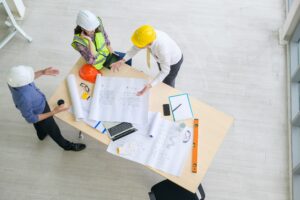
Consider the Construction Trailer
I recently attended a behind-the-scenes tour of a nature library (one of the coolest projects in our state) that’s currently under construction and scheduled to open in August. The design is stunning—rooflines that echo prairie grass in the wind, a living wall, barely a right angle in the whole building.
But what struck me even more than the architecture was how invested everyone involved seemed to be.
The construction lead pulled us all aside and said, “Let me show you my favorite room.” He walked into what will become a dark, quiet, contemplative space paneled in Japanese black wood, explaining, “This space is exactly what people need.”
This wasn’t a consultant or senior leader trying to generate buy-in. This was someone who had so fully internalized the vision that he’d become its champion.
And it didn’t happen by accident. It happened because of the construction trailer.
Every morning, the whole team gathers there. Plans on the walls, a visible roadmap. Everyone, from the general contractor to the electricians to the landscapers, checks in, sees the full picture, grabs their gear and heads out to do their part.
The concrete team is doing something very different from the landscape team. But they’re connected by a shared understanding of what they’re building and WHY.
So here’s my question for you: Where is your construction trailer?
Where’s that physical or virtual space where people can gather, consult the map, understand how their work fits into the whole, and then go execute with real ownership?
Not just once a year at a strategic planning retreat. Regularly. Consistently. Because it’s easy to get lost in the day-to-day and miss the moments when stepping back in the trailer—looking at the blueprint—would help everyone remember why they are there in the first place.
Your Fresh-Start Challenge
This is your 2026 assignment: Build your construction trailer.
Create a space where your team can see the whole picture and their place within it. Set a rhythm that makes sense for your org and commit to it.
And while you’re at it, get honest about your infrastructure needs. Not the wishlist from some hypothetical future with unlimited unrestricted funding, but what you actually need to deliver on your mission and vision…right now.
Then build the case for it like your organizational health depends on it. Because it does.
Small can be beautiful. Adaptive can be structured.
Let’s make 2026 the year we stop chasing bigger and start building better.
See you in the construction trailer,
Kimberley